Emotions. We love them. We hate them. Feelings of warmth and affection connect us to others and build a sense of security and trust. Anger, resentment and sadness do the opposite and drive us to lash out and isolate. Emotions color so much of our lives, yet we aren’t born knowing what they are or how they drive our reactions. An essential part of growing up is learning to recognize and manage our emotions. These socioemotional skills form the basis for healthy relationships, learning and personal development.
Music is an effective way to teach about emotions. Just think about how as children we listened to a major and minor chord and were told one is “happy” and one is “sad.” Think how powerful it would be if children could express what they are feeling by creating their own music!
This has been one of our mantras, and so we were thrilled to meet Tammy Vallieres, a kindergarten teacher and co-founder of Raising Empowered Kids. Tammy came up with the concept of “Hero Intelligence” based on children learning to listen and talk to their inner voices – the “victim” voice, the “villain” voice and the “hero” voice that inspires a person to grow into their best selves.
Tammy just published a children’s picture book, Harmony Hare and Her Three Voices, which introduces these ideas to young readers (and the adults who read to them) through the character of Harmony Hare. Harmony Hare’s three voices are represented by blue, pink and golden butterflies. On a recent Second Sunday, we invited Tammy to join us and play with the idea of turning the three butterflies/voices and their interactions into music.
The session turned out to be the perfect combo of story, art and music. You can see how we used Hyperscore to reinforce a story with emotional resonance, complexity and a sense of play.
Check out “The Hero in You”:
And here is our workshop conversation, in which we discuss the composing challenge before us, brainstorm various approaches and ultimately decide which ones to use.
Students at the 2023 F2F Foundation Summer Music Camp create music with Hyperscore
Connecting STEM with the Arts is as simple as opening Hyperscore, New Harmony Line’s web-based music composition tool. Anyone of any age or ability can compose in Hyperscore. Due to our generous donors, the Hyperscore classroom is available at no cost and includes our team’s educational services. As an educator, you do not need specialized music training, nor do your students, in order to incorporate music into your teaching of other subjects. Music becomes another medium, just like writing, visual arts, and model-building, for students to explore and express their understanding of a topic.
With Hyperscore, students create their own melodic and rhythmic patterns and assemble them into full musical compositions. It’s easy, intuitive and fun. Students can fine-tune their creative ideas by adding dynamics, form, different instruments and adding harmony such as chords. Finally, adding a title to the piece connects the listener to the composition’s themes.
Read on for specific ideas on how to use Hyperscore in STEAM education!
Connecting STEM with the Arts in Composition Workshops
With Hyperscore, teachers can link composition to various STEM concepts in group workshops. For example, through the Second Sunday Composition Workshop series, the New Harmony Line team has experimented with composing songs in Hyperscore inspired by mathematics, visual art, scientific concepts, technological achievements, and more. The open-ended intuitive structure of Hyperscore allows for students to take a wide variety of such inspirations. With guidance from a workshop facilitator, students’ creativity can bloom.
Replica of the Babbage Difference EngineFairy DoorFraction AttractionMelting Glacier
The following are some examples of compositions made in New Harmony Line’s Second Sundays workshops. “The Melt” was inspired by the sounds of a melting glacier. “A Song for a Forest Fairy” is a theme song for Haleigh Overseth’s fantasy character Daisy Rae whereas “Mr. Hank! and the Bucket” is a musical re-telling of the picture book There’s a Hole in the Bucket. “The Hero In You” contains a theme for each of the inner voices that challenge children to form their best identity, featuring the author of “Harmony Hare and Her Three Voices“, Tammy Vallieres.
“The Countess of Lovelace” is a piece inspired by the Babbage Difference Engine whereas “Algorithms and Music Composition in Hyperscore” takes its inspiration from programming, functions, and modular music composition. “Canon Fodder” is a reimagining of Bach’s “Canon in D” while “Dance of the Fireflies” was sparked by someone sharing a photograph by Daniel Kordan. Using a team member’s fun bebop theme brought about “Lazy Bop“, while “Aire Currents” provided an opportunity to realize new music for a dance video from YouTube. We created “My Grandfather’s Clock” when a workshop attendee was fondly reminiscing about a folk song that he sang as a child. Thankfully this list will continue with our monthly workshop, but we’ll close this section with “Fraction Attraction” an idea that came from a team member’s unit on division of the musical beat and its connection to the study of fractions in math class.
Schools, Museums, Festivals and Camps
New Harmony Line shared Hyperscore in the Boston Museum’s “Created By” Festival, the Cambridge Science Festival and Iowa City Artsfest and Jazz fest. These events allow children, their parents and community members to create music using our technology. As expected, these festivals celebrate STEAM programs that promote ingenuity, creativity and innovation. Click the play button on the sketch window to activate the linked innovation video, created by a 4 year old. What great spaces to share Hyperscore!
Students Pre K through 12th grade have written simple harmonies to incredibly complex pieces with our technology tools. 2nd grader LS completed her assignment to create whole, half, quarter and eighth notes in a percussion window. This achievement earned her independent creativity time. WOW! Step away and look what can happen. She discovered how to set the melody window to 32nd notes on her own. Indeed, her video on our YouTube channel has 120 views, more than any other student piece and rightly so.
In 2022, the F2F (Faith to Form) Foundation hosted a Hyperscore segment in their summer camp founded by composer Vel Lewis. For 2 years we had the opportunity to work with inner city youth in Houston attending his summer camp. In addition, CS4Youth hosted a Hyperscore project in 2024 for the last day of BotBall Robotics Camp held in Massachusetts. Campers created a theme song for the debut of their robot as it moved through its obstacles. What a delightful way to use technology in TWO ways!
Both the United States and international countries have enjoyed access to Hyperscore. Music Teacher Odysseas Sagredos, Greece, loved Hyperscore so much. He taught his elementary and secondary students to use the technology with incredible results. The Projectory in Seoul, South Korea hosted an interactive Hyperscore session in 2023 with students creating their work in teams. Teacher Frederico Ferohna shared Hyperscore with his music students. His classes chose two pieces to share live from Portugal on a Zoom with us to our delight.
The Hyperscore Challenge
The Hyperscore Challenge is an idea that has became hugely successful due to the embedded YouTube video prompts into the Hyperscore workspace. Anyone who participated from March to May could submit their composition(s) for our website. We published our galleries, 2024 and 2025, on International Make Music Day.
As one can imagine, the addition of video prompts added multiple STEAM opportunities:
What does outer space (age 8) sound like? Which instruments (ages 2 and 4) best portray chickens hatching and baby birds being fed by Mama bird? How does one musically describe a little girl mimicking the dance moves of a robot (age 58)? What instruments portray each character (age 3) seen in an under-the-sea vignette?
Incidentally, we discovered that the video prompts were very effective with Pre-K students as they easily chose a composition focus. With an adult utilizing a mouse, young children are able to make story line musical choices by guiding the adult’s hand and clicking the left button.
Where will Hyperscore take STEAM next? Where will STEAM take Hyperscore?
The Kennedy Center for the Performing Arts defines arts integration and STEAM as “an approach to teaching in which students construct and demonstrate understanding through an art form. Students engage in a creative process which connects an art form and another subject and meets evolving objectives in both.” The internet and social media abound with praise for initiatives such as Arts Integration and STEAM.
New Harmony Line has had amazing experiences in the last few years with STEAM through Hyperscore. Currently, a connection with the Institute for Arts Integration and STEAM led to exhibiting at the Creativity Rising Conference in July of 2025. Over 40 music teachers, arts integration specialists, classroom teachers and arts integration administrators registered for the Hyperscore Classroom. We are already planning the trip for next year!
Would you or your team like to attend a series of workshops? Professional development is at your fingertips with our workshop offerings. New Harmony Line is in the planning stages with the Arts Integration and STEAM team at BYU in Utah. We will also be presenting and exhibiting at their Arts Express Conference in 2026.
The Dallas Symphony will be debuting a wall-sized interactive Hyperscore exhibit in the Jeanne R. Johnson Music Innovation Lab in the coming month. In addition, our team is also excited about an opportunity to work with Emily and Bryan at the Lexington Public Library in Kentucky. Emily was at Creativity Rising and has some wonderful plans to use Hyperscore in their STEAM room at the library!
Your turn! Where can Hyperscore take YOUR program?
Thank you to everyone who participated in the 2025 Hyperscore Challenge! We loved hearing the pieces you created to accompany the video prompts as well as the compositions.
We’ve compiled this gallery of the pieces you offered to share for everyone to enjoy! Click each thumbnail to listen to a video of the piece or click the piece title to open it in Hyperscore.
Composing music from art was the challenge we received from our wonderful collaborator Polina Lulu. We met Polina in our group composition workshop at the 2023 Connected Learning Summit. She enchanted us, and the other participants, with her delightful compositional ideas about a polite Canadian squirrel. Not surprisingly, Polina is a Child Experience Researcher who studies learning, technology and play.
Polina loved Hyperscore so much that she agreed to be a guest on our Reimagining Music podcast in February of 2024. In the fall of 2024, she introduced her 2 young children to Hyperscore. She took note of what they were able to do instinctively with the program. In a meeting afterwards, she was able to share some really interesting ideas about how a young child might use Hyperscore.
Why not start with the art? Open the sketch window, using the colors to draw lines, squiggles and dots. Next, use the dynamics tool to make the shapes bigger or smaller. Finally, write the musical story behind the art using the melody and rhythm windows.
Start with the art
The New Harmony Line team accepted Polina’s challenge of composing music from art at our December 2024 Second Sunday Composition Workshop. The team began to use multiple colors, line shapes and dots to create a piece of art in the sketch window. Asking for lines to be copied then moved higher and lower produced interesting results. In addition, a group of squiggles and dots became a visual ‘section’. Copying and pasting these elements created an introduction, chorus and coda of color.
Polina challenged us to draw the sketch window first THEN create the melodies and rhythms to match the colors.
Composing music from art
Once everyone was satisfied with the artistry, there were musical decisions to be made. Should the blue and purple introduction be percussion or melody? Composing a cool kick pattern gave us our answer–percussion it is! Sneaking in a melody was easy when played below, then repeated above middle C.
The fiery red, yellow and orange section became our showpiece, especially with the repeat. Starting with a melody for orange, we quickly realized that a drum (red) and bass line (yellow) would make this section complete. Having art with lines that go up and lines that go down made the composing intimidating. What if they don’t sound good together?
Well, they didn’t. Fact. Keeping our challenge in mind, we decided not to change the art to fit the music. On the repeat of the chorus we doubled the orange and placed it below the original art. In contrast to our first chorus, we all agreed that doubling the melody. then differing the dynamic levels was a significant improvement! Due to these positive results, we changed the dynamics in every section.
Final review
With a one hour workshop spilling over into an additional half hour, we had to bring our work to a close. For the most part, the team agreed that drawing first then composing was really fun. It stretched our brains in imaginative ways. If we’d had time to work with the Harmony buttons we may have made a more consonant piece. However, it’s “a great stART” and a topic we can come back to any time in our fun Second Sunday Composition Workshops this year!
This month, our team had an interesting challenge, to devise a short workshop for the F2F Music Foundation’s summer camp, which serves underprivileged kids in the Houston area. The camp supports youths in developing and honing instrumental performance skills. F2F’s founder, the multifaceted Hammond organist and composer Vel Lewis, was keen to give the campers hands-on experience with technology while introducing them to Hyperscore as a tool for composition. And he wanted the campers to produce an original piece that would be performed on instruments during the camp’s final concert.
The campers range in age from seven to 17, and several participated in last year’s summer camp, so they would be able to help the novices with Hyperscore basics. But what could we do in the few hours allotted to the workshop that would be rewarding and relevant?
The camp has a jazz orientation, so we decided to start with a jazzy melody. The campers’ job would be to add accompanying melodies, bass, and percussion. While the idea sounded good in theory, we had not actually tried it out ourselves. So that’s what we decided to do at this month’s Second Sunday Zoom workshop. We composed a bebop-inspired melody in advance. Here it is:
This is what it looks like transcribed into Hyperscore:
While easy on the ears, it’s rhythmically complex, with grace notes, syncopation—elements that make a melody “swing.” We decided to start by adding a bass line, something that could underpin the melody by marking the beat against which the melody would be syncopated. We wondered whether there was a chordal structure to work from, but as we were racing against the clock, we said “let’s just use our ears.” (Plus, we don’t know the rules of jazz harmonies…) We started with a basic descending scale with some jumps, a few eighth notes thrown in among the quarter notes, and a little “grace note” beat at the very end of the phase so that when we looped it, there’d be a nice little flourish to propel us sonically into the next cycle.
Once we got a bass line that sounded good to us, we wanted to add a second melody that could weave in and out. Maybe something that “echoed” parts of the main melody. To make the “echo”, Peter copied part of the melody and plopped it into a new melody window, positioning it right after the trombone melody plays. We chose a vibraphone (yellow melody window) for the instrument because it is a bright sound that contrasts and complements the trombone nicely.
Now onto percussion! Percussion often follows the rhythmic pattern of the melody. We heard in our heads a quarter beat alternating with triplet eights. Again, copying and pasting from the main melody into the percussion window saved some time. At first, the resulting beat sounded a bit too mechanical and lacking in swing, but upon listening, it wasn’t half bad. We adjusted the volume and changed to a cymbal with a more resonant vibration and liked that much better. We threw in some other percussion instruments at various points for emphasis:
We gave it a couple more listens and enjoyed what we heard! Here it is:
We realized afterward that the process we used was a great example of motific composing, in which we copied and pasted bits from the original melody to create the other parts. This was true even as we were guided only by what we heard, not by theory.
Some pro tips: The original melody was locked using keyboard command Ctrl – shift – L (L for “lock”). That way we couldn’t accidentally change it. Also, if you watch the full video of how we created this piece, you’ll see how we stacked various windows with the bars aligned so that it was easy to see the time relationship among the different parts.
Finally, while our team managed to collaboratively create our piece in one hour, we felt this would be a very challenging project for a workshop with kids. We decided to provide more supports, including showing the chords. Unfortunately, just as we were planning this camp workshop, Houston was hit hard by Hurricane Beryl, with electrical power for much of the city knocked out for days. The camp was postponed. We hope Vel and the kids are safe and look forward to composing with them in the near future.
Here’s the full video of our Second Sunday session:
Thank you to everyone who participated in the 2023-2024 Hyperscore Challenge! We loved hearing the pieces you created to accompany the video prompts.
We’ve compiled this gallery of the pieces you offered to share for everyone to enjoy! Click each thumbnail to listen to a video of the piece or click the piece title to open it in Hyperscore.
by June Kinoshita, Executive Director, New Harmony Line
We’re constantly discovering new and wonderful ways to play with Hyperscore. Recently, Peter Torpey and I were invited to give a series of talks to music education masters students at the Longy School in Cambridge, MA. Their instructor, Garo Saraydarian, mentioned the students were in the middle of unit about Orff instruments. We had not thought about integrating Hyperscore compositions with Orff or any other type of acoustic instruments so we arrived in class without a plan.
We showed the basics of Hyperscore composition to the class of around a dozen students from diverse parts of the world and then turned them loose to compose. They worked in clusters of two to four students for about a half hour. Because all of them were already experienced in instrumental performance and theory, they could dive right in, although none of them had composed collaboratively before.
When the time was up, Garo asked each group to share their composition. And here’s when he made a simple but brilliant suggestion. After sharing the composition, they were asked to use Orff instruments to improvise an accompaniment to the Hyperscore piece.
The effect was utterly charming! The digital sound of Hyperscore set a foundation to which the students added a variety of expressive rattles, buzzes, and melodious metallophone sonorities. It was all so playful and everyone was pleased with the outcome. It was such a simple idea – any music teacher could replicate it–and yet captured the essence of music-making, with delightful results. Watch:
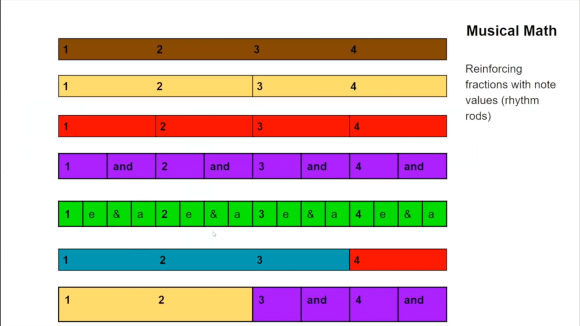
What goes on within a musical composition that can make us *feel* the driving pulse of a beat? What makes the introduction of syncopation, or stress on the off-beat, often feel so exciting and unexpected? Building a bridge between music class and math class, fractions play an essential role here. Teachers and students alike can have fun using math to compose music, and students can witness in their own compositions how fractions are fundamental to creating different musical moods. We entered into this month’s Second Saturdays workshop with the aim of composing a piece inspired by, and that could illustrate, this facet of musical math.
New Harmony Line’s Director of Education Cecilia Roudabush kicked off this month’s Second Saturdays workshop with a lesson on this concept – the rhythmic, fractional values that make up music. Understanding a single measure as a whole that can be divided up into several pieces can be easier for many when visualizing a measure as a bar or a pie cut into different sized pieces:
After a visual primer on how a whole measure can be made up of many different combinations of half, quarter, eighth, and sixteenth notes (among other values), we discussed how stress can be placed on different beats and off-beats in the measure to create different effects. For example, in 4/4 time (when there are 4 quarter-note beats per measure), many pop songs place more emphasis on beats 1 and 3 than 2 and 4, while oftentimes in jazz music more emphasis is placed on 2 and 4.
We jumped into Hyperscore to start composing with these concepts in mind. Translating Cece’s lessons into sound, we created melody windows with motifs breaking up the measure into different rhythmic values – one whole note, two half notes, four quarter notes, and eight eighth-notes:
Then, we started layering them against each other in the sketch window to hear the ways they relate to each other. We hear the articulation of a quarter note every two eighth notes, a half note every four eighth notes, for example. We ended up with an intro with each of these motives in sequence, creating a “countdown” effect, before layering them against each other and using changes in instrumentation to make the different length notes sound out clearly against each other.
The different colors in the Sketch window each represent one of the above melody windows.
We added more complexity to the piece by creating melody windows that include rests to emphasize certain beats (and off-beats). We also decided to add more interest to the composition by contrasting the single-pitch motives we were working with against a singsongy melody window with varying pitch. A percussion window demonstrated the frequent effect that rhythm sections have of underscoring stress on certain beats of the measure:
With these different elements we gradually wove together a densely textured, bright and bouncy tune. Listen to the full piece “Fraction Attraction” below – and check out the full recording of the workshop as well to see our composition process and watch how the piece came together! Join in on the fun by registering for our free composition workshops that take place every second Saturday of each month – we look forward to making music with you!
Striking and familiar yet uncanny, this sound, which we encountered in this 2020 article from The Guardian, is that of Antarctic icebergs melting. The sound of rushing water is punctuated by an eerie and percussive whooshing and popping sound, which, as the article explains, is the sound of primordial air breaking out of millennia-old bubbles, held no longer by the ancient, now melting, ice.
We listened to this in the context of taking inspiration from clips of sound from the world for musical composition. How might we translate the feelings that came up, and the rhythms of the sound of the melt itself, into music? We set out to find one answer to this question during the workshop.
We began by naming the feelings and atmospheres that were evoked for each of us when we listened to the sound of the iceberg. Themes arose as we spoke of familiarity, awe, uneasiness, uncanniness, and surprise. What sounded like rushing water in the clip was a familiar, even comforting sound, but the interruption of the strange popping sound gave an edge to this feeling. The additional context that knowledge of climate change gave to the sound – the melt reaching farther into the ice, and getting louder, every year – added a somber, even grim, undercurrent. We wanted to approach composition both mirroring what we were literally hearing (a constant, smoother sound punctuated by sudden and unexpected pops) and the emotional reactions that this sound and its context created in us.
Moving into Hyperscore, we decided to start with some melody windows that could serve as an ambient, slow backdrop to the piece, using notes with long durations and in a low register, using a timpani and strings for our instrumentation.
We then created some strokes to correspond to these motifs in the Sketch window. The result was melodically tense and rather menacing.
We had our “consistent” sound which we then wanted to break up with unexpected interruptions and percussive splashes. To add a rhythmic yet unpredictable element we composed two faster-moving melodic motifs on pizzicato strings – one with a measure broken up into 3 notes of equal value (in other words, a half-note triplet), and one with a measure broken up into 4 notes of equal value (in other words, quarter notes).
When played together and layered into the Sketch window, they created a kind of rhythmic dissonance and a sense of driving momentum that broke above the surface of the steady and slow sounds we started with. We decided to emphasize this sudden and inconsistent effect to introduce these new sounds in the Sketch window (represented by the light and dark green strokes) as fragments that would pop in and out before returning in earnest and persisting for what would become the climactic moment of the composition:
To add even more emphasis to this climactic section and create a mood of mounting urgency, we created another 3-against-4 rhythmic figure on woodblock in two Percussion windows and added this in the Sketch window as well:
The intensity of the climactic section increased with the addition of the orange and purple percussion motives.
We liked it but found that we were deviating some from the unpredictable sense that we got from the popping in the initial iceberg sound clip. To reintroduce that surprise, we created a version of the green motifs that was a bit more sparse, while still maintaining the 3-against-4 feel, and applied this to the green strokes only in the latter half of our piece.
We decided to tweak the percussion windows as well, making the note attacks much more rapid and inconsistent and adding in some triangle hits:
We continued on with this process of listening to our composition, reacting to what we were hearing, then making changes and additions according to our reactions. Through this process in the course of the rest of the hour-long workshop, we added a mournful, soft ambient drone of low flute and organ, and a jerking, syncopated melody played on pizzicato strings.
We arranged all of the building blocks we had created into a form that ebbed and flowed between themes of rattling urgency and dirge-like somberness. Without planning to, we ended up creating a rather atonal and dissonant piece that nonetheless carried in its undercurrent a driving movement that enthralled us when we listened to the final product. We ended by titling it, appropriately, “The Melt”.
Listen to the final, 80-second-long composition below, along with a recording of the full workshop including our brainstorming, composing and editing process.
Iceberg image courtesy of Angie Corbett-Kuiper via Unsplash
For the May edition of our Second Saturdays composition workshop, we chose not to write from a prompt. It can often feel risky or intimidating to face the prospect of creating “something from nothing” – where to begin? It was precisely for this reason that we wanted to experiment with this process. Hyperscore shines when composers lead with an open mind, and can help to lower the barriers of “the blank page”. Composers of all experience can learn to trust their musical intuition with the tools of Hyperscore.
Using Hyperscore, we simply began by choosing an instrument set -folk band – and putting down some notes into a percussion window. We added one percussion instrument at a time, reacting to what we were hearing when we played it back. What does this instrument sound like? Do we want fast or slow notes, on the beat or off the beat? Most importantly, how does it feel to listen to it, and do we want it to feel different? We ended up with a steady, dense rhythm that was heavy on syncopation and evoked a slow, erratic march:
Next, we moved on to add some melodies. We agreed to start by creating a bass line riff that could repeat throughout the piece, forming a solid, catchy underpinning. Going through several iterations and asking each other what we heard and what we imagined was essential for the composition process. The bass developed into a two-instrument section, with one bouncy, quick motif complementing a swaying legato figure. After listening to them all together in a Sketch window, we made some edits to the melody windows so they would stand out and complement each other better and landed on our final versions:
Adding all three motives into the Sketch window, we decided to use the Classical harmonic mode and to experiment with creating regions of tension and release with the Harmony Line. Fine tuning these sections meant plenty of listening back, making slight changes, and then listening again.
We had rhythm, a bass line and a basic harmonic structure – now a piece was really starting to develop! It was time to bring in more melody. We created two variants on one melodic theme – a lightweight twinkling dance on a music box, and a half-speed repetition of the same theme, lower and more dramatic, on guitar:
We also decided to add an additional, more stripped down version of our main rhythm theme to add some variety and interest throughout the composition.
Weaving together all the elements in the Sketch window, making edits and additions following our intuitions and desires, we landed with a piece that had an uneven yet regimented feel. For us it was evocative of animated clocks ticking in and out of time. It reminded one of our participants of the classic tune “My Grandfather’s Clock”, after which we named the composition.
Listen to the final composition below, and watch the recording of the the full workshop, including our process of brainstorming and editing:
Photo of clocks courtesy of Andrew Seaman via Unsplash