
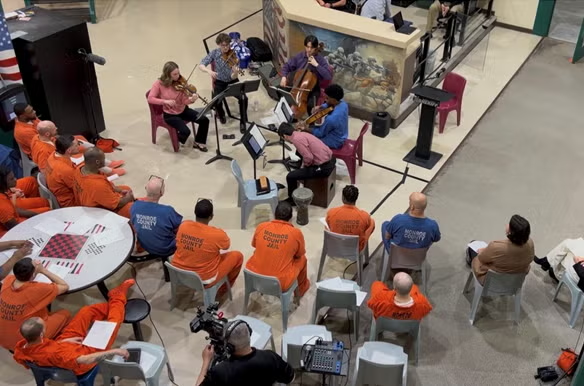
Frank Cremaldi has battled addiction for 20 years. Last spring, while held at the Monroe County Jail in Rochester, New York, he did something new. He wrote a piece of music, start to finish, and heard student musicians from the Eastman School of Music play it.
“Being in addiction, I mean it’s hard to start something and finish it,” Cremaldi told WHEC News. “This gave me an opportunity to start something, to finish something, to be proud of something, which at the end of the day, just motivates me to do better.”
Cremaldi was one of eight men in the jail’s rehabilitation program who took part in a four-week pilot led by Elinor Freer, associate professor of piano and chamber music at the Eastman School of Music. The tool at the center of it was Hyperscore.
Composing without a barrier to entry
Most people never get the chance to compose music. Traditional composition assumes years of lessons, an instrument and the ability to read and write notation. For people who never had access to those things, the door is closed before they reach it.
Hyperscore was built to open that door. Developed at the MIT Media Lab, it lets anyone “draw” music. Composers place colored dots and lines to create melodies and rhythms, then sketch those ideas into a larger piece. A harmony line adds tension and release. Every choice plays back instantly, so composers learn by listening, adjusting and listening again. “No prior training is needed,” said June Kinoshita, executive director of New Harmony Line, a nonprofit that distributes Hyperscore.
That matters. When the technical barriers fall away, what remains is the person and what they want to say.
Four weeks, one concert
For four weeks in April 2026, the men met with Freer for a one-hour class twice a week, according to the Monroe County Sheriff’s Office. Each participant composed a short, personal work. Eastman students then workshopped the pieces in real time, playing back what the composers had written so they could hear their ideas take shape.
The project ended May 8 with a concert inside the jail. Five Eastman students performed the new works for string quartet and percussion before an audience of other incarcerated people and jail staff.
The titles tell their own story. One man dedicated his piece, “Breaking Through Barriers,” to his recovery and the joy he finds in sobriety. Another wrote “Surrender,” inspired by his relationship with his mother.
The Eastman musicians understood what they were holding. “We wanted to honor what they’d written,” said Amelia Posner-Hess, a violinist. “It wasn’t our music anymore.”
An instrument for social change
Freer is clear that the project was never only about music.
“I think the most beautiful thing about this project is, it’s really not about the music,” she told Spectrum News. “The music is the tool, but what it really is about is learning skills, life skills, making decisions, working as a team, working collaboratively.”
Composing in Hyperscore asks people to make hundreds of small decisions. Which note comes next? Does this section need more tension? Is the piece finished? Each answer is the composer’s own. For someone working toward recovery, the experience of making choices, living with them and seeing a project through can be powerful.
It also changes how people see themselves, and how others see them. “When you do time, you get locked up and the last imprint that people have of you is the negative thing you were doing,” Cremaldi told WHEC. “To be in here and to do something positive, it gives me something to be proud of.”
That is the shift from audience to creator. Eastman had brought concerts to the jail before. This time, the men inside wrote the music.
What comes next
The project now carries a new name, “Breaking Barriers,” chosen by one of last spring’s participants. Freer is leading a second pilot, this time with women in the jail’s rehabilitation unit.
After that, Breaking Barriers becomes a for-credit course in Eastman’s chamber music department. It will follow the Inside-Out Prison Exchange Program model, a teaching method created at Temple University that brings campus-based students and incarcerated students together to study the same material as peers. In Freer’s class, both groups will compose Hyperscore pieces side by side. Eastman students will perform every piece at the end of the course.
Freer said Hyperscore showed her once again “why it is such an incredible tool for learning and engagement.”
“Music is one of the most powerful and effective tools that exists for someone seeking to reclaim their life and sense of self,” she said. “Creating and listening to music allows us to tap into the innermost parts of ourselves, parts that are critical for healing and moving forward. And providing our Eastman students with this opportunity to see how their music can be used as an instrument for social change is one of the best educational experiences we can give them.”
We at New Harmony Line are moved and grateful to have played a small part in this work. Hyperscore began with a simple belief: everyone has a musical voice worth hearing. Breaking Barriers shows what can happen when people are given the tools to use it.
Read more about Breaking Barriers in Rochester Review.
Bring Hyperscore to your community. Hyperscore Classroom is free for schools and educators and includes support from our team. Learn more about Hyperscore.